

Summary
The RDA vs RDH decision comes down to how much schooling you want to complete, what kind of daily work you enjoy, and how much of your career you want built around independent clinical scope versus chairside support. Neither path is objectively better than the other, they are simply built for different strengths and different goals.
This guide compares the real differences between a Registered Dental Assistant and a Registered Dental Hygienist: how long each program takes, what the pay difference actually reflects, what a typical day looks like in each role, and how much flexibility each path offers if you want temp or PRN work later in your career. Mayday works with both RDAs and RDHs across its network of more than 2,000 vetted dental professionals, so this comparison draws on what we actually see practices asking for and what professionals in each role tend to want out of their careers.
What RDA and RDH Actually Mean
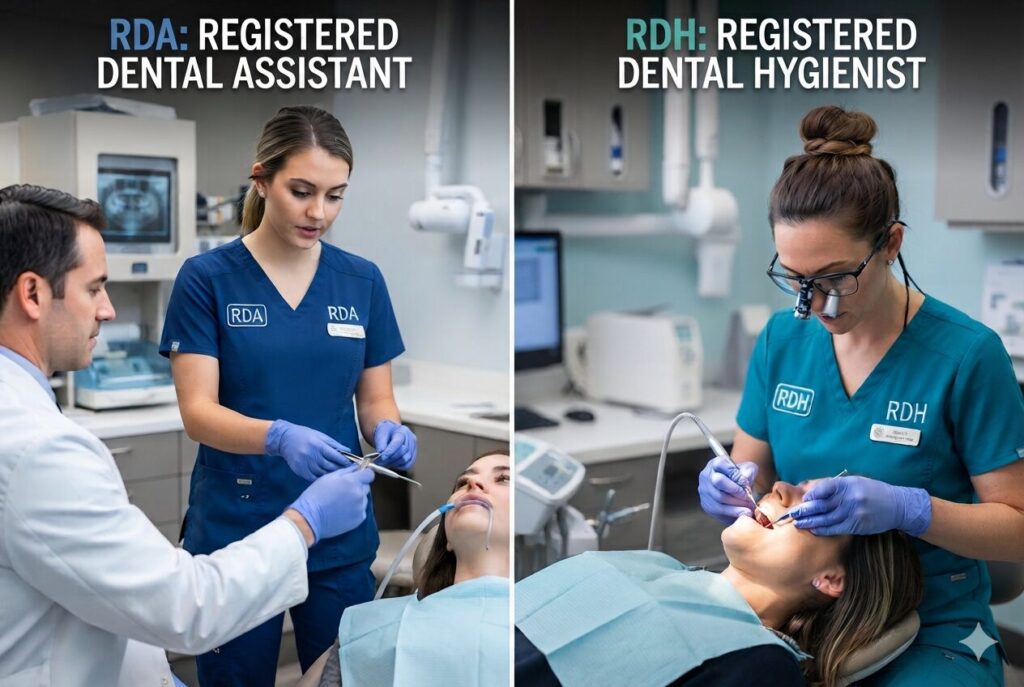
An RDA, Registered Dental Assistant, supports the dentist chairside during procedures, handles instrument sterilization, takes X-rays, and manages a lot of the behind-the-scenes flow that keeps a dental office running smoothly. A RDH, Registered Dental Hygienist, works more independently, performing cleanings, periodontal assessments, and patient education, often seeing their own patients for scheduled appointments without a dentist present in the room the entire time. Our breakdown of DA vs. RDA vs. CDA is worth reading first if you are still sorting out the different assistant credentials, since the RDA piece of that comparison feeds directly into this one.
Education and Training: Time and Cost Compared
Becoming an RDA
Dental assistant training is generally the faster and less expensive path into the field. Depending on your state, you can become qualified through a combination of on-the-job training and a certificate program, sometimes in well under a year. Some states require passing a state or national exam and completing a set number of clinical hours, but the overall timeline and cost tend to be significantly lower than hygiene school.
Becoming an RDH
Becoming a hygienist requires an accredited dental hygiene program, almost always an associate degree at minimum, and increasingly a bachelor’s degree for hygienists interested in teaching or research roles later on. This typically takes two to three years of full-time study, including significant clinical hours, followed by both a written and clinical licensing exam. Our guide to getting a license to work as a dental hygienist walks through the licensing process state by state in more detail.
- RDA: certificate or on-the-job training path, often under a year, lower upfront cost
- RDH: associate or bachelor’s degree, typically two to three years, higher upfront cost and more clinical hours
- Both paths require passing state-specific exams before you can legally practice
- Both paths can lead to further specialization or continuing education later in your career
What the Day-to-Day Work Actually Looks Like
On paper, the difference between these roles is about scope of practice. In practice, it is really about what kind of work feels satisfying to you day after day.
A Typical Day as an RDA
An assistant’s day moves fast and covers a lot of ground. You might be prepping a room for a crown in the morning, taking X-rays before lunch, and helping the dentist through a filling in the afternoon, all while managing sterilization and turnover between patients. It suits people who like variety, who enjoy supporting a provider directly, and who like the pace of moving between different procedures throughout the day. Our article on core dental assistant skills covers what tends to separate a strong assistant from an average one.
A Typical Day as an RDH
A hygienist’s day is usually built around a series of scheduled patient appointments, each one largely run independently: reviewing health history, performing a cleaning, checking for signs of periodontal disease, and educating the patient on their home care before the dentist comes in for a quick exam. It suits people who want more autonomy during the appointment itself and who enjoy building a longer relationship with the same patients over repeat visits, since hygienists often see the same people every six months for years.
Pay Differences and Why They Exist
The dental assistant vs hygienist salary gap is real, and it is not arbitrary. It mostly comes down to education, licensing scope, and the level of independent clinical judgment each role requires.
Hygienists generally earn more than assistants, often by a meaningful margin, because the additional years of schooling and the broader clinical scope of an RDH license reflect a higher level of training and independent responsibility. That said, experienced assistants with additional certifications, especially those comfortable with expanded functions where state law allows it, can close some of that gap over time. Our article on why dental hygienists make more money than dental assistants breaks the numbers down further, and our dental hygienist salary guide by state for 2026 is a useful reference if pay by location matters to your decision.
Mayday works with a network of more than 2,000 vetted dental professionals across both assistant and hygienist roles, with an average time-to-fill of 5 to 7 days for practices looking to bring either one on, whether temporarily or permanently.
Career Growth and Flexibility in Each Path
Neither path is a dead end, and both have real room to grow if you want it.
- RDAs can pursue expanded function certifications in many states, take on office management responsibilities, or move toward roles like dental office administration over time.
- RDHs can move into specialized practices like periodontics or pediatrics, take on clinical education or public health roles, or pursue further schooling toward a bachelor’s or master’s degree.
- Both RDAs and RDHs can build a career around flexible, temp, or PRN work rather than a single full-time employer, picking up shifts across multiple practices instead of committing to just one.
That last point matters more than a lot of professionals realize when they are still in school. Temporary and PRN work is not just a stopgap between permanent jobs anymore, for a lot of assistants and hygienists it has become a genuine strategic career choice. Our article on temporary work as a strategic career move looks at why more professionals are choosing flexibility over a single full-time role, whether that means trying out different practices, controlling their own schedule, or simply avoiding the burnout that can come with one demanding office.
Curious what temp or PRN shifts actually pay in your area? Explore opportunities for dental hygienists or browse dental assistant roles to see what is available near you.
A Simple Self-Assessment: Which Path Fits You?
If you are still deciding, a few honest questions can point you in the right direction faster than a pros-and-cons list ever will.
- Do you want to be back in the workforce earning a paycheck within a year, or are you comfortable committing two to three years to school first?
- Do you enjoy variety and fast-paced support work, or do you prefer running your own scheduled appointments with more independence?
- Are you drawn to the idea of building long-term relationships with the same patients over years, which is common in hygiene, or do you prefer the faster rhythm of assisting across many different procedures?
- How important is starting pay to you right now, versus a longer runway toward higher earning potential later?
- Would you rather ease into the field with lower upfront cost and see how you like it, potentially going back for a hygiene degree later, or dive straight into the bigger commitment?
There is no wrong answer here. Plenty of RDAs build long, satisfying careers and never feel a need to become hygienists. Plenty of RDHs knew from the start that they wanted the independence and pay that comes with the additional schooling. And a fair number of hygienists actually started out as assistants first, using that experience to confirm hygiene school was the right next step before committing to it.
Talking to People Who Have Walked Both Paths
One of the most useful things you can do before committing to either path is talk to real assistants and hygienists about what their day actually feels like, not just what the job description says. Shadowing a shift, even for half a day, tends to reveal things a program brochure never mentions: how much time a hygienist spends on paperwork between patients, how physically demanding chairside assisting can be during a long procedure, or how much a hygienist’s schedule can vary depending on whether a practice runs a strict recall system or a looser one.
It is also worth asking working professionals in each role what they wish they had known before choosing their path. Most will tell you honestly that the schooling was only part of the decision. The bigger factor tended to be whether the daily rhythm of the work matched their personality: fast and varied for many assistants, steady and relationship-driven for many hygienists. Neither answer is right or wrong, and plenty of people would be equally happy in either role. The goal of asking around is simply to reduce the number of surprises once you are a year or two into a program you have already paid for.
If you already work in the field in one role and are weighing whether to cross over to the other, agency shifts can be a low-risk way to get exposure to different practice environments before committing to a bigger decision like going back to school. Working a variety of temporary shifts also tends to clarify what you actually enjoy about the job, separate from how any one specific office happens to run things.
Frequently Asked Questions
Is RDA or RDH better as a career?
Neither is objectively better. An RDA path gets you into the workforce faster with less upfront cost, while an RDH path takes longer and costs more but generally leads to higher pay and more clinical independence. The better fit depends on your own goals, timeline, and what kind of daily work you enjoy.
What is the main difference between a dental assistant and a dental hygienist?
A dental assistant works chairside supporting the dentist during procedures, while a dental hygienist works more independently, performing cleanings and periodontal assessments directly with patients. The hygienist role requires more schooling and a broader scope of independent clinical practice.
How much more does an RDH make compared to an RDA?
The gap varies by state and experience level, but hygienists typically earn noticeably more than assistants, reflecting the additional years of schooling and broader licensing scope required to become an RDH. Location matters quite a bit here, which is why checking a state-by-state salary breakdown is worth doing before assuming a national average applies to you.
Can a dental assistant become a dental hygienist later?
Yes, and it is a common path. Many hygienists worked as assistants first, which gave them real exposure to the field before committing to the additional schooling required for an RDH license. That prior experience often makes hygiene school easier since the clinical environment is already familiar.
Which path offers more flexible or temporary work options, RDA or RDH?
Both paths offer solid temp and PRN opportunities. Hygienists especially tend to have an easier time picking up single-day or part-time shifts across multiple practices because of how independently they can work an appointment, but plenty of assistants build flexible schedules around agency work as well.
Do I need a college degree to become a dental assistant?
Not necessarily. Many states allow entry through a certificate program or on-the-job training rather than a full college degree, which is part of why the RDA path is generally faster and less expensive than becoming a hygienist.
Should I choose RDA or RDH if I’m not sure I want to commit to years of school right away?
Starting as an RDA is a reasonable way to enter the field, earn a paycheck, and get real clinical experience while you decide if hygiene school is worth the additional investment later. It is not the only path, but it is a practical one if you are genuinely unsure.
Whichever path you choose, Mayday can help you find work that fits your schedule and your goals. Visit the professionals hub to see current opportunities for both RDAs and RDHs.