


Summary
Skills-based hiring in dentistry means evaluating a candidate’s actual chairside ability, patient rapport, and real-world competency instead of screening mainly by years of experience, where they trained, or how polished their resume happens to look. More dental practices are shifting toward this approach because resume-first hiring keeps producing mismatched placements, even when every credential on paper checks out perfectly.
This guide walks through why a resume alone cannot tell you whether someone is good at the job, what skills-based recruiting actually looks like inside a dental practice, why it matters even more for temp and temp-to-perm placements, and how to build hiring criteria that go beyond years of tenure without ever skipping the credentials that still matter. You will also find a practical way to apply this thinking whether you are filling a hygienist seat, an assistant role, or a dental office manager position.
The Problem With Resume-First Dental Hiring
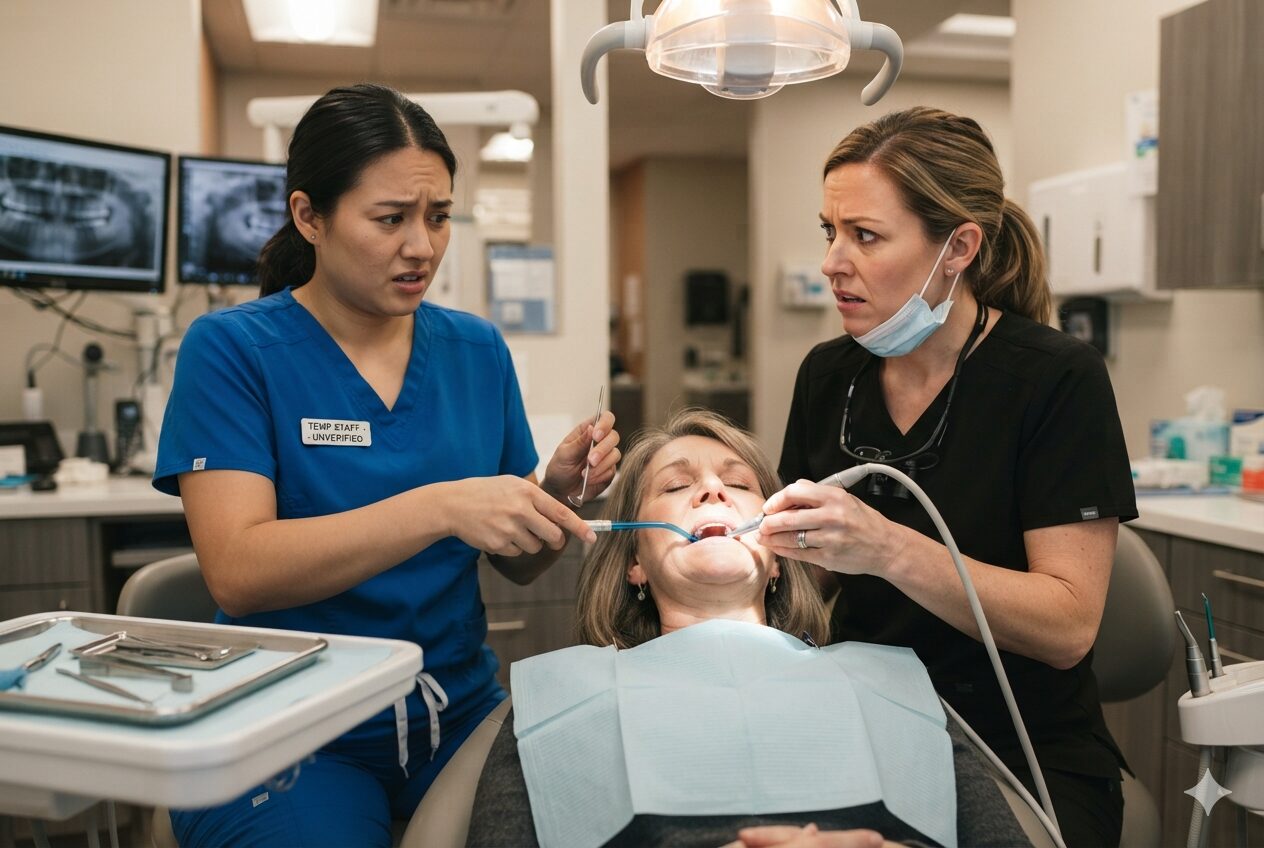
A resume tells you where someone worked and for how long. That is about all it reliably tells you. It does not tell you whether they are fast and steady on a four-handed procedure. It does not tell you whether patients relax around them or tense up the moment they walk in. And it definitely does not tell you whether they actually retained what their program taught them, versus just passing the exam and moving on.
Practices that screen almost entirely on years of experience and school name routinely end up with hires who look great on paper and struggle once they are actually in the chair. Just as often, that same approach passes over a genuinely skilled candidate whose resume happens to be thin. Tenure and pedigree are proxies for skill. They are not the same thing, and treating them as interchangeable is exactly how an otherwise careful practice ends up with a hiring mismatch nobody saw coming.
What Skills-Based Hiring Looks Like in a Dental Practice
Skills-based recruiting in a dental practice means building your evaluation around the specific things the role actually requires. A few questions worth asking during any hire.
- Can this hygienist manage a full recall schedule without falling behind by mid-afternoon?
- Can this assistant anticipate a dentist’s next move during a procedure, instead of waiting for instructions every time?
- Does this front-desk hire handle an anxious or frustrated patient with the same steadiness as a routine one?
- How does this candidate actually perform under a busy, back-to-back schedule, not just a calm interview room?
These are testable, observable things, not guesses you are making from a job history. Skills-based hiring simply structures your process to actually check for them, instead of assuming years of tenure guarantees they are already there.
Competency-Based Hiring Matters Most for Temp and Temp-to-Perm Roles
Competency-based dental hiring is not just an HR philosophy sitting in a handbook somewhere. It becomes especially practical the moment you need to fill a role fast. When you have weeks to hire, you can lean on interviews, references, and a working relationship that develops slowly over time. When you need someone in the chair tomorrow through temporary staffing, or you are evaluating a temp-to-perm fit before committing to anything permanent, you simply do not get that kind of runway.
You need a way to know, quickly, whether this person can actually do the job. That is exactly why skills and competency evaluation matters more for on-demand and short-notice placements than it does for a slow, traditional hire spread out over a month.
Dental Hiring Criteria Beyond the Resume: What to Actually Evaluate
Credentials are still the floor, not the ceiling. An RDA, RDH, CDA, or EFDA license confirms someone is legally qualified and has met a training standard. That part is not optional, and it is still worth verifying every single time, no exceptions. But dental hiring criteria beyond the resume should also account for a few other things.
- Comfort level with the specific procedures your practice runs most often
- Speed and accuracy under a genuinely full daily schedule
- How someone handles a difficult or anxious patient in real time
- Whether they communicate clearly with the rest of the clinical team mid-procedure
None of that shows up on a license number or a list of past employers. A structured working interview, a short skills checklist during onboarding, or even direct observation during a trial shift can surface this information in a way a resume simply cannot.
Why This Applies Across Roles, Not Just One Position
This shift is not specific to hygienists or assistants. It applies anywhere you are filling a seat. A hygienist might have the right license and five years of experience, but a slow, inconsistent chairside pace that only shows up once they are actually working. A dental assistant might be newer to the field but exceptionally quick and calm under pressure. A specialist filling in for a few days needs to demonstrate procedure-specific comfort fast, not just show up with a diploma.
It applies just as much to a dental office manager hire, a role practices often still screen almost entirely on years of front-office experience. The skills that actually predict success in that seat are scheduling judgment, how someone handles an insurance dispute or an unhappy patient in real time, and whether the clinical team actually trusts their decisions under pressure. None of that shows up reliably on a resume either. Skills-based thinking applies the same evaluation logic across every role you are staffing, whether you are filling one seat for a single day or building out a multi-location team over the next year.
Ready to hire for real fit instead of resume keywords? Start hiring with Mayday and get matched with professionals evaluated on the skills your seat actually needs.
What Gets Lost When You Screen on Tenure Alone
Years of experience is an easy number to sort candidates by, which is probably why it shows up so often in dental hiring criteria. But two candidates with the same ten years on paper can have completely different day-to-day ability. One may have spent a decade in a slow-paced, low-volume office. The other spent three years in a fast, high-volume practice and developed sharper chairside instincts in a fraction of the time.
Screening on tenure alone treats those two candidates as equivalent, when they clearly are not. It also tends to filter out newer graduates and career-changers who may already have strong hands-on skill but simply have not logged the years yet. These are candidates a skills-based process would catch, and a resume-first process would likely miss entirely, sometimes to the practice’s own detriment down the line.
Here is a question worth sitting with for a moment. Of the last three hires who did not work out at your practice, how many of them looked strong on paper going in? If the honest answer is most of them, that is not bad luck repeating itself. That is a signal that your screening process is measuring the wrong things, and it is a pattern worth fixing before the next opening rather than after it.
How Skills-Based Dental Recruiting Puts This Into Practice
Evaluating real skill instead of just resume keywords is genuinely harder to do by hand, which is exactly the gap smarter matching is built to close. Mayday’s intelligent candidate profile matching looks past job titles and years of experience to match practices with professionals whose actual skills and working style fit the role, not just candidates who technically meet the minimum qualifications on paper.
Combined with credential verification on every professional before they are eligible for a shift, this is a practical version of skills-based hiring built directly into how a placement gets made. You can browse current openings on Mayday’s jobs page to see the range of roles this applies to, from hygienists and assistants to office managers and specialists.
Mayday’s network includes more than 2,000 vetted dental professionals placed across more than 20,000 filled shifts nationwide, matching built on evaluating fit for the specific role, not just resume keywords, at a scale that makes skills-based screening practical rather than a slow, manual exercise.
A Simple Way to Start Hiring on Skills This Month
You do not need to overhaul your entire hiring process overnight to start seeing the benefit. A few small, practical changes go a long way.
- Add one structured working interview or trial shift to every clinical hire, even a short one.
- Write down the two or three real skills each open role actually needs, before you post the job.
- Ask every candidate the same two or three scenario-based questions, so you can compare answers fairly.
- Keep credential verification as a non-negotiable step, regardless of how strong the skills evaluation looks.
Small changes like these are usually enough to catch the mismatches a resume alone would have let slip through, without turning your hiring process into something slow and complicated.
Frequently Asked Questions
What is skills-based hiring in dentistry?
It is an approach that evaluates a dental candidate’s actual clinical and interpersonal competencies, chairside skill, procedure comfort, patient communication, instead of relying mainly on years of experience or where they trained.
How is competency-based hiring different from traditional dental recruiting?
Traditional recruiting leans heavily on resume signals like tenure and school pedigree. Competency-based hiring tests or observes the actual skills the role requires, which more reliably predicts how someone will actually perform on the job.
Does skills-based hiring mean credentials don’t matter?
No. Licenses and certifications like RDA, RDH, CDA, and EFDA remain a non-negotiable baseline. Skills-based hiring adds real competency evaluation on top of verified credentials. It does not replace them.
Can a newer graduate compete with an experienced candidate under skills-based hiring?
Often, yes. If a newer graduate demonstrates strong hands-on competency, skills-based evaluation gives them a fair shot against a more tenured candidate whose actual chairside performance may not be as strong as their resume suggests.
Why does skills-based hiring matter more for temp dental staffing?
With short-notice or temp placements, you do not have weeks to learn whether someone is a good fit through observation alone. Evaluating real skills upfront is how you get that confidence quickly, instead of discovering the answer on day one in front of a patient.
How does Mayday evaluate dental candidates beyond their resume?
Mayday’s intelligent candidate profile matching considers a professional’s actual skills and fit for a role, paired with license and credential verification before they are ever eligible for a shift.
How do I write a job posting that actually attracts skills-based candidates?
Describe the real day-to-day of the role instead of just listing years of experience required. Mention the pace of your schedule, the procedures you run most, and the kind of patients your team sees. Candidates who are genuinely strong on skills tend to respond well to a posting that sounds like the actual job, not a generic list of requirements copied from somewhere else.
If your hiring process still leans mainly on years of experience and where someone trained, it is worth rethinking what you are actually screening for. Fill a staffing need with Mayday and fill your next role with a candidate matched on real fit, not just resume keywords.