


Summary
A last-minute sick call is one of the most stressful things an office manager or dentist can face. One phone call at 7 AM can unravel an entire day of carefully scheduled appointments. This blog gives you a clear, step-by-step plan for handling last-minute dental staff absences quickly and calmly, including how to get qualified temporary coverage fast through a dental staffing agency, how to manage your patients, and how to make sure this situation is less painful the next time it happens.
The Morning Every Dental Office Manager Dreads
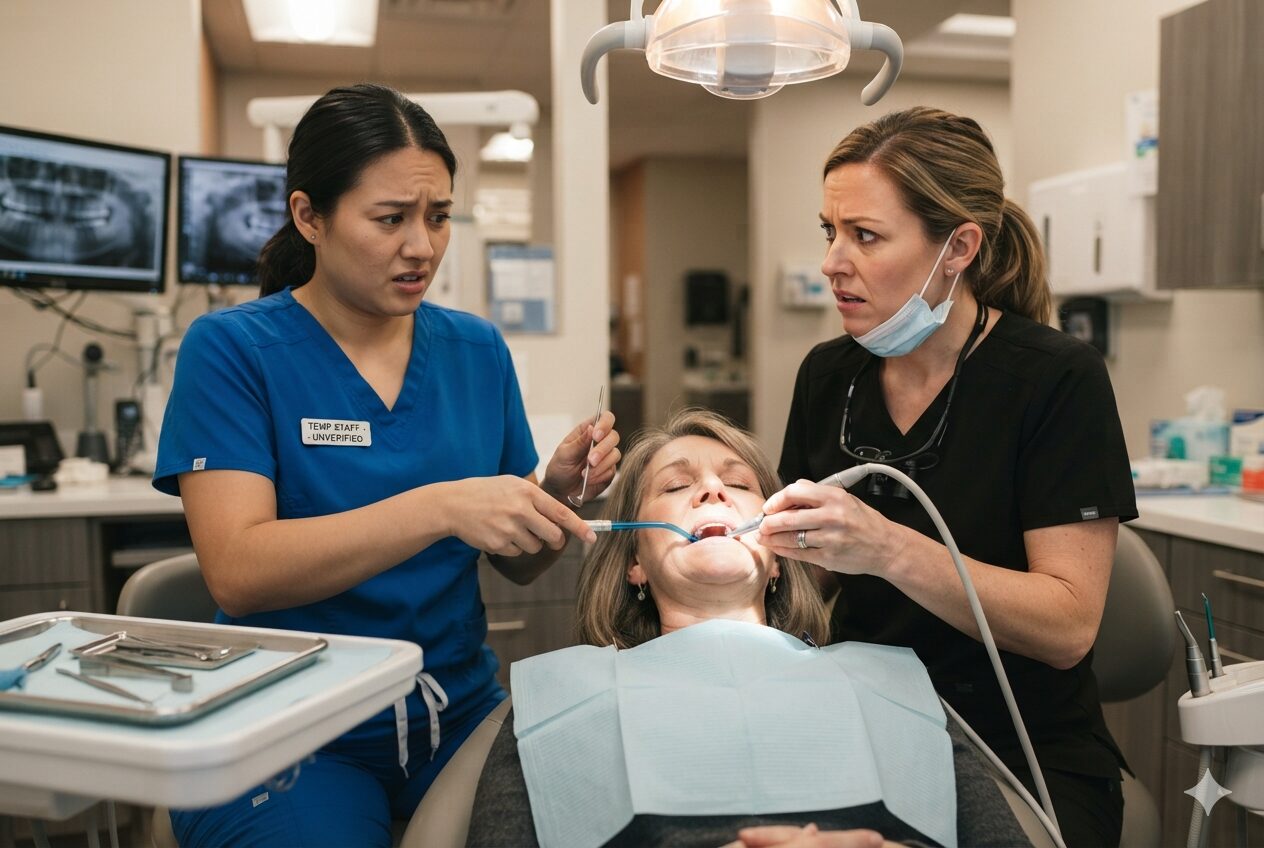
It is 7:12 AM. Your first patient arrives at 8:00. Your phone buzzes and it is your hygienist. She woke up with a fever and could not come in.
Your stomach drops. You have a full hygiene schedule, two patients who specifically requested her, and a front desk person who is already stretched.
If you have been in dental practice management for any amount of time, you have lived this exact moment.
Maybe it was the dental assistant who no-showed. Maybe it was two people calling out on the same day. Whatever the specific situation, the feeling is the same: you need someone qualified, licensed, and reliable in your office within the hour, and you have no idea where to get them.
This guide exists so that next time, you already have the answer. And that answer starts with having a relationship with a reliable dental staffing agency before the crisis hits.
Step One: Do Not Panic. Take Stock.
Your first instinct might be to start calling every number in your phone. Resist that. Take two minutes to assess before you act. Ask yourself:
• What role is out? Clinical (hygienist, assistant) or front office?
• How many patients are scheduled that specifically need this person?
• Is any part of the schedule adjustable?
• Do you have any part-time or on-call staff you can reach?
Knowing the answers to these questions before you make your first call will make every conversation more efficient. You will sound composed, which matters when you are reaching out to a staffing agency at 7 AM.
Step Two: Assess What You Actually Need
Not every sick call is a five-alarm emergency.
Sometimes a patient can be moved to later in the week. Sometimes a dental assistant absence is manageable if the dentist adjusts their schedule slightly.
Before you call a dental staffing agency, know specifically what role you need covered and for how long.
Temporary placements through Mayday can be made for as little as a single day or for multiple days in a row. Having a clear picture of what you need helps the agency match you faster and more accurately.
The more specific your request, the faster Mayday can match you. Role, hours needed, and any key clinical requirements are the three things to have ready.
Step Three: Contact Your Staffing Agency Immediately
If you already have a relationship with a dental staffing agency like Mayday Dental Staffing, this is the moment that relationship pays off.
Call or text Mayday as early as possible. The earlier you reach out, the better your chances of getting a qualified professional placed before your first appointment.
Mayday’s system is designed exactly for this scenario.
The team communicates quickly, typically via text, and taps into a pre-vetted pool of dental professionals who are available for same-day and short-notice shifts. You do not need to post a job, read resumes, or run an interview. Mayday handles all of that upfront so that when you call, someone is already available.
If you do not yet have a relationship with a dental staffing agency and this is your first time reaching out, call (888) 899-4386 as early as possible.
Mayday works hard to accommodate same-day requests, and the earlier you call, the better the outcome.
When you make the call, have the following ready:
• The role you need covered
• The hours for the shift
• Any specific credentials required (for example, RDH with local anesthesia certification)
• The name and address of your practice• Any software or clinical equipment the temp should know about
Step Four: Communicate with Patients Proactively
While the staffing situation is being handled, your front desk should be proactively reaching out to patients at risk of disruption.
The goal is to contact anyone whose appointment may be affected before they show up and wait.
Patients respond much better to an early heads-up than to showing up and being told the news in person.
A short, honest phone call or text works well. You do not need to explain the internal situation in detail. Something like “We have a scheduling change this morning and want to reach out early to give you options” goes a long way.
If you are able to get a temp placed before the appointment, you can follow up and confirm. Patients appreciate the communication regardless of the outcome.
Step Five: Adjust the Day’s Schedule
Even with a temp placed, the day may need some adjustment. Here are a few practical things to consider:
• Prioritize patients who cannot be rescheduled: Post-op checks, patients who drove from far away, or patients who have rescheduled before should stay on the books.
• Move lower-urgency appointments: Routine cleanings or cosmetic consultations are usually easier to reschedule than restorative work.
• Brief your temp quickly: Give the incoming professional a five-minute orientation when they arrive. Where are the charts, what software you use, and who to ask if they have a question.
• Check in throughout the day: Have a designated team member available to support the temp as needed.
Step Six: Debrief After the Day
Once the day is over, take 15 minutes with your team to talk through what happened. Ask:
• How well did the coverage situation go overall?
• What information did the temp need that we should have ready next time?
• Which patients need a follow-up call or a scheduling priority next week?
• What could we do differently to make this easier if it happens again?
This debrief does not need to be long or formal. But the habit of learning from each staffing gap will make your clinic more resilient over time.
How to Prevent the Same Crisis Next Time
The best time to solve the problem of a last-minute sick call is before it happens. Here are the steps that will make the next one far less stressful:
• Keep a clinic overview document ready: A one-page summary of your practice, software, key contacts, and protocols for a temp to read on arrival.
• Cross-train your team where possible: The more flexibility your existing staff has, the easier it is to cover partial gaps.
• Build your absence policy: Make sure your team knows how to report absences and what the process is so you find out as early as possible.
Practices that have an established on-demand dental staffing partner already in place consistently handle sick days with far less disruption than those scrambling to find help from scratch.
Why Mayday Dental Staffing Is Built for This Moment
Mayday Dental Staffing exists precisely because dental offices face these situations every single day.
The platform is built for speed.
Dental professionals in the Mayday network are pre-screened, credentialed, and available for short-notice and same-day placements. The text-based communication system means you are not waiting on hold or in an email thread when time is tight.
Office managers across the country have shared that Mayday’s response time and reliability are what keep them coming back. When your hygienist calls out at 7 AM, you want to know that help is on the way by 7:30.
10. Final Thoughts
A last-minute sick call will always be an inconvenience. But with the right plan and the right dental staffing agency in your corner, it does not have to be a crisis. The practices that handle these moments well are the ones that are prepared ahead of time.
Set up your Mayday Dental Staffing account today so the next time your phone rings at 7 AM, you already know what to do. Visit maydaydentalstaffing.com or call (888) 899-4386.