

Summary
Dental license verification means confirming, directly with the state licensing board, that a hygienist, assistant, or dentist holds an active credential in good standing before they treat a patient. It usually takes only a few minutes per person, and it is one of the cheapest risk controls a practice has.
This guide walks an office manager through what to verify for each role, how to check it against the primary source, which extra screenings are worth adding, and how to keep a record that holds up if anyone ever asks. It also covers what to expect from a staffing agency, so you know which checks are handled for you and which still land on your desk. Last updated October 2026.
Key Takeaways
- Verify from the issuer, not from a photocopy: use the state board’s own license lookup, and the certifying body for certificates.
- Check three things every time: the license is active, it has not expired, and there is no discipline on file.
- Requirements differ by state and by role, so the right list for a Texas assistant is not the right list for a California one.
- Screen exclusion lists and run background checks with the correct consent and notice steps.
- Save a dated record of every check and put expiration dates on a shared calendar.
Why Verification Belongs Before the First Shift
Most practices verify credentials at hire and then never think about it again.
The trouble is that a license is not a permanent fact. It can lapse, be restricted, or be suspended, and a resume or a photocopied certificate will not show that.
The only reliable way to know is to look at the board’s record on the day you rely on it.
The stakes are practical, not theoretical.
A clinician practicing without a valid credential exposes the practice to board complaints, insurance problems, and patient harm, and the practice that scheduled the person carries part of that exposure.
If you want the bigger picture of what goes wrong when screening is skipped, our piece on why unvetted dental staffing puts your practice at risk covers it. This article is the how-to that sits underneath it.
Verification is also getting harder to do by eye.
Altered documents and polished AI-written resumes are now common enough that a good-looking file proves very little, which is why AI hiring risks in dental recruiting all point back to the same fix: check the source.
What to Verify, Role by Role
There is no single national dental credential, so the list changes with the role and the state. Treat the lists below as a starting framework and confirm the specifics with your own state board.
Dental Hygienists
- An active state hygiene license, with the license number, issue date, and expiration date.
- Disciplinary status: any probation, restriction, or past action shown on the board record.
- Local anesthesia, nitrous oxide, or other permits, in states where those are separate authorizations and your practice plans to use them.
- Current CPR or Basic Life Support card, checked with the issuing organization if the card allows it.
- Radiography authorization, if your state treats it as a separate certificate.
Dental Assistants
Assistants are where state rules diverge the most.
The U.S. Bureau of Labor Statistics notes that states typically do not require licenses for entry-level dental assistants, that some require graduation from an accredited program and an exam, and that others rely on on-the-job training.
Many states still require a license, registration, or certification for specific duties such as radiography, infection control, or coronal polishing.
Some examples of how much this varies:
In California, operating dental x-ray equipment requires state radiography certification, and Registered Dental Assistant licensure follows its own pathways, which the Dental Board of California changed on July 1, 2025.
In Texas, taking dental x-rays requires a Dental Assistant Radiology Certificate from the State Board of Dental Examiners.
In Arizona, it requires a current board-approved certificate in dental radiology. Rules change, so check the board before you rely on any summary, including this one.
- Any state license or registration the role requires, such as an RDA license.
- Radiography, coronal polish, sealant, or infection control certificates where your state requires them.
- National certification such as CDA, which the Dental Assisting National Board (DANB) lets employers check through its online credential verification.
- Current CPR or BLS card.
Dentists and Specialists
- Active state dental license with no restrictions, and specialty credentials where the role calls for them.
- DEA registration if the dentist will prescribe controlled substances.
- Proof of malpractice coverage for contractors and locum dentists, and confirmation of whose policy applies.
- Exclusion list screening, covered below.
Front Office and Administrative Staff
Front desk, treatment coordinators, and billing staff do not hold state dental licenses, but they still need a credential check of a different kind.
Confirm identity and work eligibility through the standard I-9 process, check references, and confirm any HIPAA or insurance-billing training the role depends on.
How to Verify From the Primary Source
The same six steps work for nearly every credential. The only thing that changes is which website you use.
- Collect the details before you look anything up: full legal name as it appears on the license, license or certificate number, state, and role.
- Go to the licensing board’s official license lookup yourself rather than following a link the candidate sends. In Mayday’s deepest-coverage states that means the Dental Board of California, the Texas State Board of Dental Examiners, the Florida Department of Health, the Arizona State Board of Dental Examiners, the Nevada State Board of Dental Examiners, and the Oregon Board of Dentistry.
- Read the status, not just the name. You are looking for an active license, a current expiration date, and no discipline or restrictions.
- Verify certificates with the body that issued them. For DANB-issued credentials, use DANB’s online verification. For other certificates, ask the issuer how they confirm authenticity.
- Screen the exclusion lists described below, and run any background check through a compliant process.
- Record the result: the date, the site you used, what it showed, and who checked. A saved PDF or screenshot is enough.
If the board record and the paperwork disagree on a name, a license number, or a date, stop and resolve it before the person works. A mismatch is usually an honest error, but it is never something to wave through.
Exclusion Screening and Background Checks
Two checks sit outside the license lookup, and practices that bill federal healthcare programs should know about both.
Exclusion Lists
The HHS Office of Inspector General keeps a List of Excluded Individuals and Entities (LEIE). Federal healthcare programs generally will not pay for services furnished by an excluded person, so employing or contracting with one can create real liability.
Healthcare compliance vendors widely recommend checking new hires before they start and then screening the whole team at least monthly, and some also suggest checking SAM.gov and your state Medicaid exclusion list. These frequency recommendations come from industry practice rather than a single official rule, so ask your compliance advisor what fits your payer mix.
Background Checks
If you use a third-party screening company, the federal Fair Credit Reporting Act sets the process. In general, you need the candidate’s written permission before ordering the report.
If you decide not to hire based on something in it, you must first give the person a copy of the report and a summary of their rights, allow reasonable time to dispute errors, and then send a final notice.
The FTC’s guidance for employers explains the steps. Many states add their own rules, so have your employment counsel or HR advisor review your process once.
Healthcare compliance guidance commonly recommends screening every team member against the OIG exclusion list before they start and at least monthly after that, because a person who was clear at hire can appear on the list later.
Expiration Dates Are the Check Most Practices Miss
A clean lookup in March tells you nothing about October. Licenses renew on cycles that vary by state, CPR and BLS cards commonly last two years, and permits can carry their own renewal and continuing education conditions. The fix is boring and effective: put every expiration date on a shared calendar with a reminder 60 days out, and make renewal proof part of the employee file.
- Log the expiration date for every license, permit, and certificate at the time you verify it.
- Set a reminder 60 days before expiry and again at 30 days.
- Ask for proof of renewal, then verify it with the board rather than accepting a receipt.
- Re-run exclusion screening on a monthly schedule, not only at hire.
- Keep verification records for as long as your record-retention policy requires.
Red Flags That Deserve a Second Look
Most candidates are exactly who they say they are. These patterns are the ones worth slowing down for.
- A name on the application that does not match the name on the board record.
- A license number from a different state than the one the candidate says they practice in.
- Copies of certificates that cannot be confirmed with the issuer.
- Reluctance to let you look up the license, or a lookup link supplied by the candidate instead of the board’s own site.
- Unexplained gaps or overlapping dates between jobs and credential issue dates.
- A license status that is inactive, delinquent, or pending when the candidate describes it as active.
Pending or lapsed status does not always mean bad intent, since renewals get delayed. It does mean the person should not treat patients until the record shows an active license.
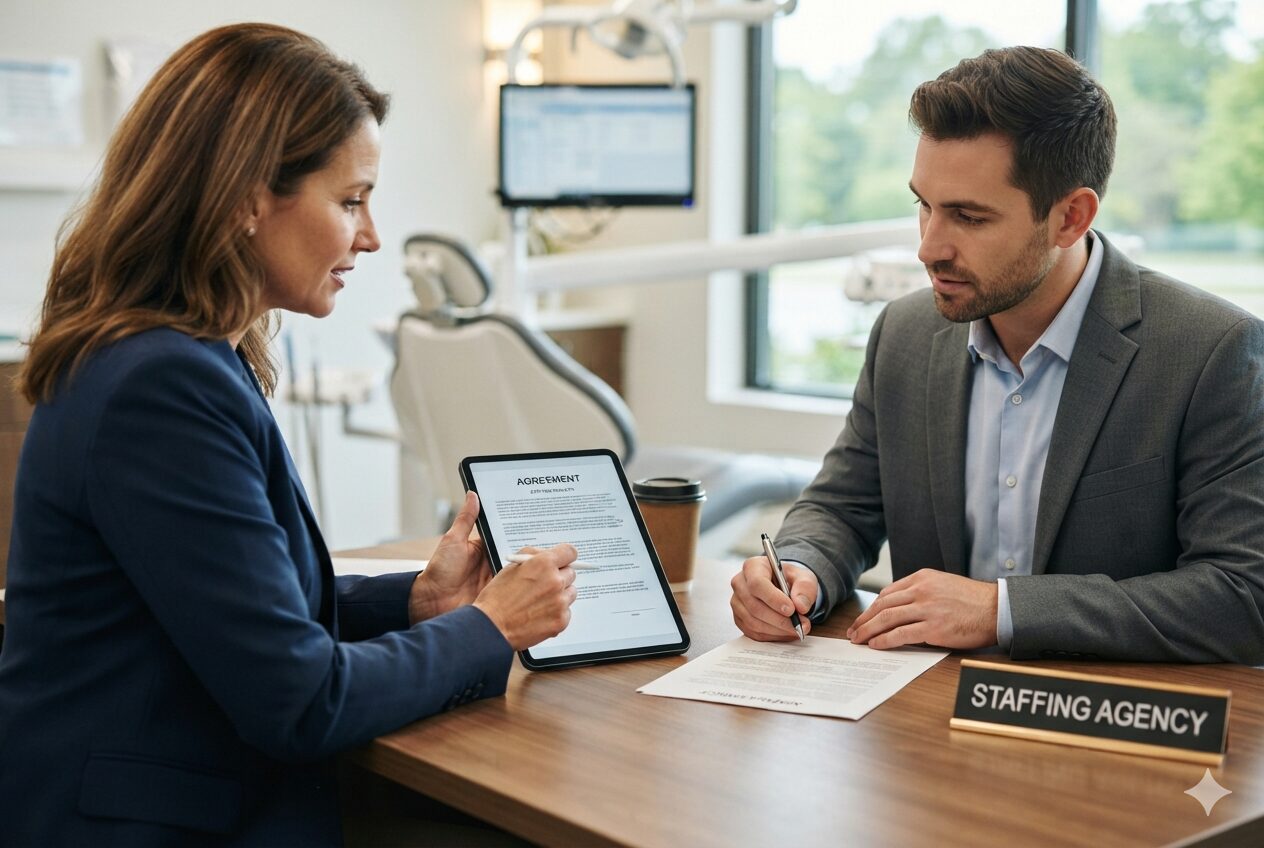
What a Staffing Agency Should Verify for You
A good agency takes credential screening off your plate, but you should know exactly how much.
When you use temporary or permanent placement, the practice is still the place where care is delivered, so you want to be able to see the proof rather than take it on faith.
Our guide on how to choose the best temporary dental staffing agency covers the wider selection criteria. For credentials specifically, ask any agency, Mayday included:
- Which credentials are checked before a first shift, and against which primary sources.
- Whether checks are repeated, and how often, for people who work with you regularly.
- What happens when a license or certificate is close to expiring.
- Whether you can see a record of the verification for any professional placed with you.
- Who is responsible if a credential turns out to be invalid, and how that is stated in the agreement.
Mayday’s network includes more than 2,000 vetted dental professionals.
The point of the questions above is not to doubt an agency. It is to make sure the answers are written down in terms you can rely on.
For the wider legal picture, see our overview of dental staffing compliance and licensure requirements across U.S. states.
A Simple Verification Routine You Can Run in 15 Minutes
- Before the offer or first shift, run the board lookup and read the status, expiration, and discipline fields.
- Verify any required certificates with the issuer, and note the expiry dates.
- Run exclusion screening and, where appropriate, a background check with consent.
- Save the evidence in the employee or contractor file with the date and your initials.
- Add every expiry date to the shared calendar.
- Repeat the lookup at renewal time and the exclusion check monthly.
If you want to compare your current process against a checklist, our guide for employers on hiring dental staff and the hygienist-focused hiring criteria for dental hygienists are good companions.
Frequently Asked Questions
How do I verify a dental hygienist license?
Search the state dental or health board’s official license lookup using the hygienist’s name or license number. Confirm the license is active, check the expiration date, and read any disciplinary information. Save a dated copy of the result for your records.
How long does dental license verification take?
Most online lookups return a result within minutes. Certificates that must be confirmed directly with an issuer, or boards that require a written request, can take longer, so allow extra time when you are hiring for a start date.
What credentials does a dental assistant need?
It depends on the state and the duties. Some states require no license for basic supportive work, while others require licensure, registration, or certificates for tasks such as radiography, coronal polishing, or infection control. Your state dental board publishes the rules for your area.
Do I need a background check for temporary dental staff?
Requirements vary, and many practices expect any outside professional to have been screened. If you order your own check through a screening company, follow the consent and notice steps required by the Fair Credit Reporting Act. If an agency screens the professional, ask to see what was checked.
Who is responsible for verifying a temp’s credentials, the agency or the practice?
Usually the agency performs the initial screening, but responsibility depends on the agreement. Ask for the process in writing, and keep your own record of the key facts, such as the license status and expiration date, for anyone who works in your operatories.
Build a verification routine that your whole team can follow. Explore Mayday’s dental practice solutions or call (888) 899-4386 to talk through your credential checks with our team.