


Summary
Temp to hire dental staffing means bringing a hygienist, assistant, or other team member into your practice on a temporary basis first, then converting them to a permanent employee once you both agree it is a good fit. It gives you a real trial period with an actual working professional, instead of a hiring decision based on a resume and one interview.
This guide breaks down how a trial period actually works, including who pays the professional during the trial and how the conversion itself happens once you are ready to make an offer. You will also get a simple framework for deciding when temp to hire is the smarter move compared to a straight permanent search or a short-term temp fill. Mayday’s network includes more than 2,000 vetted dental professionals across the country, with an average time-to-fill of 5 to 7 days, so building in a trial period does not have to mean waiting weeks longer to get someone in your chair.
What Temp to Hire Dental Staffing Actually Means
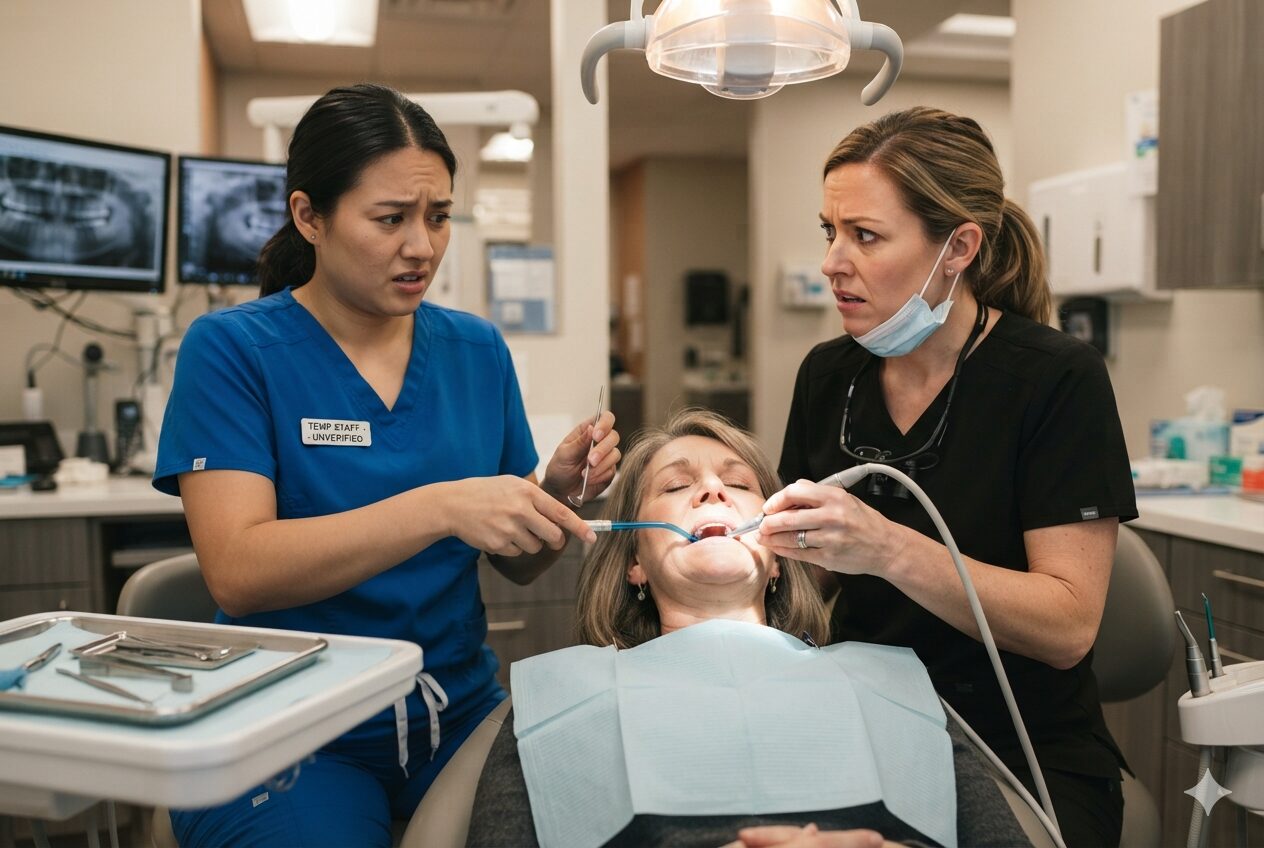
Temp to hire is exactly what it sounds like. A professional works at your practice on a temporary basis, usually through a staffing agency, for a set period of time. During that stretch, you get to see how they actually perform: how they treat patients, how they fit with your team, and whether they show up on time and handle a busy Friday afternoon without falling apart. If it works out, you convert them to a permanent employee on your own payroll. If it does not, you simply let the temporary arrangement end and try again with someone else.
How It’s Different From a Straight Temp Fill or a Straight Permanent Hire
A straight temporary fill is meant to cover a gap: a maternity leave, a busy season, a vacancy while you search for someone permanent. There is usually no plan to keep that person long term, though sometimes it happens anyway. A straight permanent hire skips the trial step entirely. You interview, you check references, you make an offer, and the person starts as a full employee from day one. Temp to hire sits in between those two approaches. It borrows the flexibility of temporary staffing and points it toward a permanent outcome, so you are not gambling on a hire you have only met in interviews. For a deeper look at how temporary and permanent staffing paths differ more generally, our guide on temporary vs. permanent dental hygienist staffing walks through the tradeoffs in more detail.
When Temp to Hire Makes More Sense Than the Alternatives
Temp to hire is not the right tool for every open seat. But it tends to be the smartest option in a handful of common situations.
- You have been burned before by a permanent hire that looked great on paper and did not work out in the chair.
- You are opening a new location or adding a new provider and are not yet sure how much staffing you will need long term.
- The role has a lot of patient-facing responsibility, like a hygienist who will be alone with patients most of the day, and the stakes of a bad fit feel high.
- You want to see how someone handles your specific software, your specific patient mix, or your specific pace before committing.
- You are replacing someone who left on short notice and need coverage now, but you also want the option to hire that same person permanently if it clicks.
Notice that none of these situations are really about the professional’s qualifications. A temp to hire trial is not a way to double-check someone’s license or clinical skill, an agency should already be verifying that before anyone sets foot in your office. It is a way to check fit: the parts of a hire that a resume and a 45 minute interview simply cannot tell you.
How the Trial Period Actually Works
The mechanics of a trial period are simpler than most office managers expect, but there are a few details worth understanding before you start one.
Who Pays the Professional During the Trial
During the temporary phase, the professional is typically employed by the staffing agency, not by your practice. That means the agency handles payroll, taxes, and workers’ comp for the hours worked at your office, and you pay the agency a bill rate for the shifts. This matters because it removes a lot of the administrative burden from you during the trial, and it also means you are not on the hook for unemployment costs or severance if the arrangement does not work out.
How Long Should a Trial Period Last
There is no single right answer, but most practices land somewhere between a few weeks and a couple of months. A very short trial, just a few days, rarely gives you enough information beyond basic reliability. A trial that drags on for six months without a decision starts to feel unfair to the professional, who may be looking at other permanent opportunities in the meantime. A reasonable middle ground is to set an expected timeline up front, something like 30 to 60 days, and revisit it honestly at the halfway point instead of letting it drift.
How Conversion Happens
Once you decide to convert someone from temporary to permanent, the process usually involves a conversion fee paid to the staffing agency, which reflects the placement value the agency provided even though the person already worked for you for a while. The exact terms vary by agency, so it is worth asking about conversion fees before the trial even starts, not after you have already decided you want to keep someone. A transparent agency will lay this out clearly at the beginning rather than surprising you with it later.
Mayday has filled more than 20,000 dental shifts nationwide, with an average time-to-fill of 5 to 7 days compared with a 42 to 63 day industry average, giving practices room to run a real trial period without falling behind on coverage.
Temp to Hire vs. Pure Temporary vs. Pure Permanent: A Decision Framework
It helps to think of these three options as points on a spectrum rather than completely separate categories. Here is a simple way to decide which one fits your situation.
- Choose pure temporary staffing when you know the need is short-term, like a vacation, a leave of absence, or a seasonal bump. You do not need a trial period because you are not trying to make a permanent hire at all.
- Choose pure permanent hiring when you already know exactly what you need, you have hired successfully for this role before, and speed matters more than an extended trial. This works best for roles where the job itself is fairly standard and predictable.
- Choose temp to hire when the stakes of a bad fit are high, when you are uncertain about long-term staffing levels, or when a past hiring mistake has made you want more information before committing. It costs a bit more time up front, but it usually costs less than a bad permanent hire that does not last six months.
If your bigger concern is the total cost of staffing mistakes rather than just the mechanics of a trial period, our article on how to lower your total labor cost looks at this from a broader budget angle, including how turnover and mis-hires quietly add up over a year.
Not sure which staffing path fits your current opening? Visit the dental practice hub to see how Mayday supports temporary, temp to hire, and permanent placements side by side.
Common Mistakes Practices Make With Temp-to-Hire
A few patterns show up again and again when a temp to hire arrangement does not go smoothly.
- Never discussing the conversion fee until the practice already wants to hire, which can sour a good working relationship right at the finish line.
- Treating the trial professional like a guest instead of a real team member, which makes it hard to judge how they would actually perform as a permanent hire.
- Letting the trial period run indefinitely with no checkpoint conversation, leaving both sides guessing about where things stand.
- Skipping feedback during the trial and only delivering it, positive or negative, at the very end.
Most of these mistakes come down to communication, not the staffing model itself. A temp to perm dental assistant placement works best when everyone involved, the practice, the agency, and the professional, understands the plan and the timeline from day one.
How Mayday Handles Temp-to-Hire Placements
Mayday supports all three paths under one system, so you are not stuck choosing an entirely different vendor depending on whether you need someone for a week, a trial period, or a permanent seat. You can fill a staffing need for a short-term gap and later decide to extend the arrangement toward a permanent hire, or start out clearly labeling the request as temp to hire from the beginning so expectations are set for everyone involved.
Because every professional in the network is already vetted and credentialed before their first shift, you are not spending your trial period double-checking basic qualifications. That time gets spent on what actually matters in a trial: watching how someone works. If a permanent search is the better fit for your situation instead, our permanent dental staffing strategy guide is a good next read, and Mayday’s permanent dental staffing agency page covers how a direct-hire search works from start to finish.
Is Temp to Hire Worth the Extra Step?
It is fair to ask whether a trial period is worth the extra time when you already have a chair sitting open and patients waiting. The honest answer is that it depends on how confident you already feel about the role and the market you are hiring in. If good candidates are scarce in your area and a strong applicant is unlikely to wait around for a 30 day trial, a straight permanent offer might genuinely be the better call. But if you have room to be patient, the extra few weeks of a trial period is usually cheap insurance against a hire that does not last.
Think about what a bad permanent hire actually costs once you add it all up: the time spent interviewing and onboarding, the training hours from your existing team, the disruption to patients who got used to a new face and then saw them leave a few months later, and the fact that you are right back where you started, searching again. Compared against that, a temp to hire trial period that costs you a slightly higher hourly bill rate for a month or two starts to look like a smart trade rather than an inconvenience.
- A trial period costs you time and a somewhat higher bill rate compared to a direct permanent hire.
- A failed permanent hire costs you all of that time again, plus training hours, plus the disruption of another transition for your patients and your team.
- A successful temp to hire placement gives you a permanent employee you have already watched perform, which tends to mean a smoother first year and less early turnover.
Frequently Asked Questions
What does temp to hire mean in dental staffing?
It means a professional works at your practice on a temporary basis, usually through a staffing agency, before either side commits to a permanent role. It gives the practice and the professional a real trial period based on actual work, not just interviews.
How long does a temp to perm dental assistant trial usually last?
Most trial periods run somewhere between 30 and 60 days, though this varies by agency and by role. It helps to agree on an expected length up front rather than leaving it open-ended.
Who pays the dental professional during a trial period?
During the temporary phase, the staffing agency typically remains the employer of record and handles payroll, taxes, and related costs. The practice pays the agency a bill rate for the hours worked.
Is temp to hire more expensive than hiring permanently from the start?
It can involve a conversion fee once you decide to hire the professional permanently, but many practices find it less expensive overall than a bad permanent hire that leaves within a few months, since turnover carries its own real costs in lost productivity and repeated hiring.
Can a practice end a temp to hire arrangement if it isn’t working out?
Yes. That is one of the main advantages of this approach. If the fit is not right, the temporary arrangement simply ends, without the more complicated process of terminating a permanent employee.
Does Mayday charge a conversion fee for temp to hire placements?
Conversion terms are discussed directly with your Mayday contact before a trial period begins, so there are no surprises once you decide you want to bring someone on permanently. You can reach the team at (888) 899-4386 or [email protected] to ask about current terms for your situation.
What’s the difference between a trial period dental hire and a working interview?
A working interview is usually a single shift or a couple of shifts used mainly to evaluate fit before any offer is made. A temp to hire trial period is longer and more like real employment, giving both sides weeks rather than hours to make a confident decision.
Ready to try before you commit to a permanent hire? Contact Mayday to set up a temp to hire placement and get a qualified professional in your practice while you decide.