
Summary
The best dental staffing agencies by state are not the ones with the biggest national footprint.
They are the ones that can show real local coverage, understand what your state requires of each role, fill shifts quickly, and put their fees in writing.
Those four things matter more than a ranking on any list.
This guide gives you a five-point test you can apply to any agency in any state, explains why state rules change the answer, and lists the questions to ask on a first call.
It does not rank named competitors, because a fair ranking would require evidence no outside article can provide. It gives you the criteria so you can run the comparison yourself. Last updated October 2026.
Key Takeaways
- Judge an agency on five checks: local coverage, state credential know-how, fill speed, fee transparency, and support when something goes wrong.
- State rules for hygienists and assistants differ, so an agency that works well in one state may need local expertise in another.
- Ask how fill speed is measured. The clock should start at your request and stop at the first shift worked.
- A national network and a local presence are not opposites. The strongest agencies combine both.
- Ask for pricing and terms in writing before you request coverage, not after.
Why the Best Agency Depends on Where Your Practice Is
A staffing agency is only useful if its professionals can reach your operator.
A national brand with a thin bench in your metro will quote you a long wait.
A local office with a deep bench but no system for credentials may fill a shift quickly and leave you with paperwork gaps. What you want is the point where the two meet: nearby professionals, proper vetting, and a process that works the same way every time.
State rules add another layer. Dental licensing is regulated state by state, so the same role can carry different requirements in different places.
An agency that serves your state well should be able to explain those requirements without checking a manual.
If you want a deeper comparison of paying an agency versus hiring directly, our breakdown of dental staffing agency versus in-house hiring cost is a useful companion.
The Five Checks for the Best Dental Staffing Agencies by State
1. Local Coverage That Is Real, Not Listed
Many agencies list a state on a map without having professionals in your city.
Ask how many vetted professionals are within a reasonable commute of your practice, which roles they cover, and how recently they worked a shift.
A real answer is specific: a market, a role, and a typical response time.
2. Credential Know-How for Your State
Ask the agency which credentials it verifies for each role in your state and which primary sources it uses.
A strong answer names the licensing board and the separate certificates that apply, such as radiography authorization for assistants.
Our guide to dental license verification lists what a thorough check looks like, so you can hold any agency to that standard.
3. Fill Speed You Can Measure
Every agency claims to be fast. Ask for the definition.
A useful measure starts when you submit the request and ends when a professional completes the first shift, split by role and by planned versus same-day requests.
Mayday reports an average time-to-fill of 5 to 7 days against a 42 to 63 day industry average, and you should ask any agency to describe its own number the same way.
4. Fee Transparency
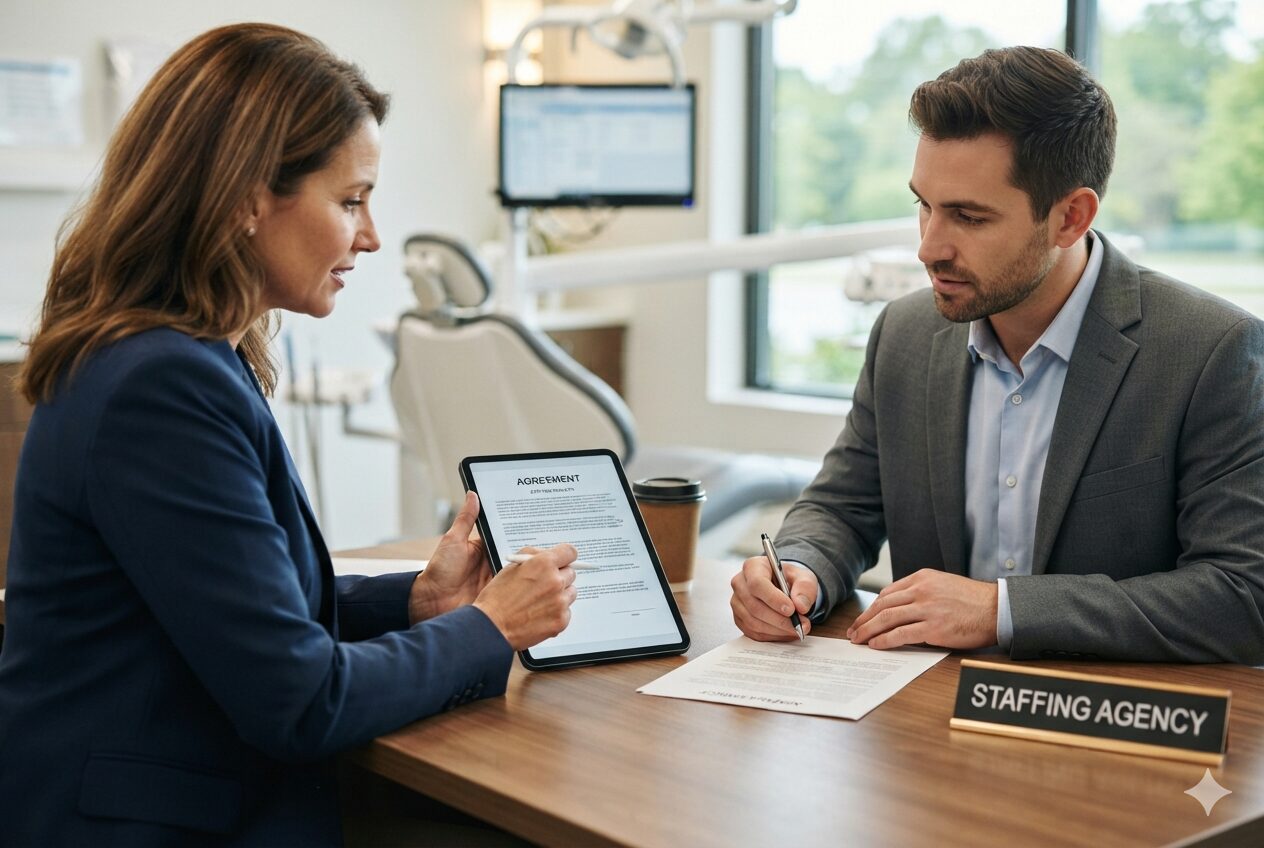
Request the rate sheet and the agreement before you need coverage.
Check conversion fees, cancellation terms, and guarantee periods, not only the hourly rate.
Our guide to the dental staffing agency contract walks through the nine clauses worth reading closely, and our look at dental staffing agency pricing explains how rates are built.
5. Support When Something Goes Wrong
Shifts change, people get sick, and sometimes a placement is not the right fit.
Ask what happens when a professional cancels, who you call, and whether there is coverage outside business hours. A quick, clear answer tells you more than a polished brochure.
How State Rules Change the Answer
Here is why this matters in practice.
The U.S. Bureau of Labor Statistics reports that states typically do not require licenses for entry-level dental assistants, that some require graduation from an accredited program and an exam, and that others have no formal education requirement.
Many states do require licensure, registration, or certification for specific duties, including radiography and infection control.
The same assistant may be fully qualified in one state and need an extra certificate in another.
These examples show how much variation there is. They reflect published board information at the time of writing, so confirm the current rules with each state’s dental board.
- California: operating dental x-ray equipment requires state radiography certification, and the Dental Board of California changed the pathways to Registered Dental Assistant licensure on July 1, 2025. For California-specific comparisons, see our guide to staffing agencies in California.
- Texas: taking dental x-rays requires a Dental Assistant Radiology Certificate issued by the State Board of Dental Examiners.
- Arizona: operating dental x-ray equipment requires a current board-approved certificate in dental radiology.
- Florida, Nevada, and Oregon: each has its own board and its own rules for assistants and hygienists, so check the board directly rather than assuming they match a neighboring state.
There is also a longer-term change to watch.
The Dentist and Dental Hygienist Compact is designed to let licensed practitioners in member states earn a privilege to practice in other member states.
The compact’s own website reports that 13 states have enacted it, that it has reached activation status, and that compact privileges are not yet being issued while an implementation process of roughly 18 to 24 months plays out.
You can check current status at ddhcompact.org. Until a compact privilege is actually in effect for a professional, treat licensing as state by state.
National Network or Local Office: Which Is Better?
The honest answer is that you want both. A purely national agency can be fast at scale but may not know your market.
A purely local agency may know your market but struggle when you need to cover several locations or a sudden spike.
Ask each agency how it handles two situations: a same-day call-out in your city, and a request across several of your locations in different states.
Group practices and DSOs should read our overview of multi-location dental practices before they compare options.
Mayday combines local professional density with a national network: more than 2,000 vetted dental professionals and more than 2,000 dental offices, with an average time-to-fill of 5 to 7 days against a 42 to 63 day industry average.
Where Mayday Operates Today
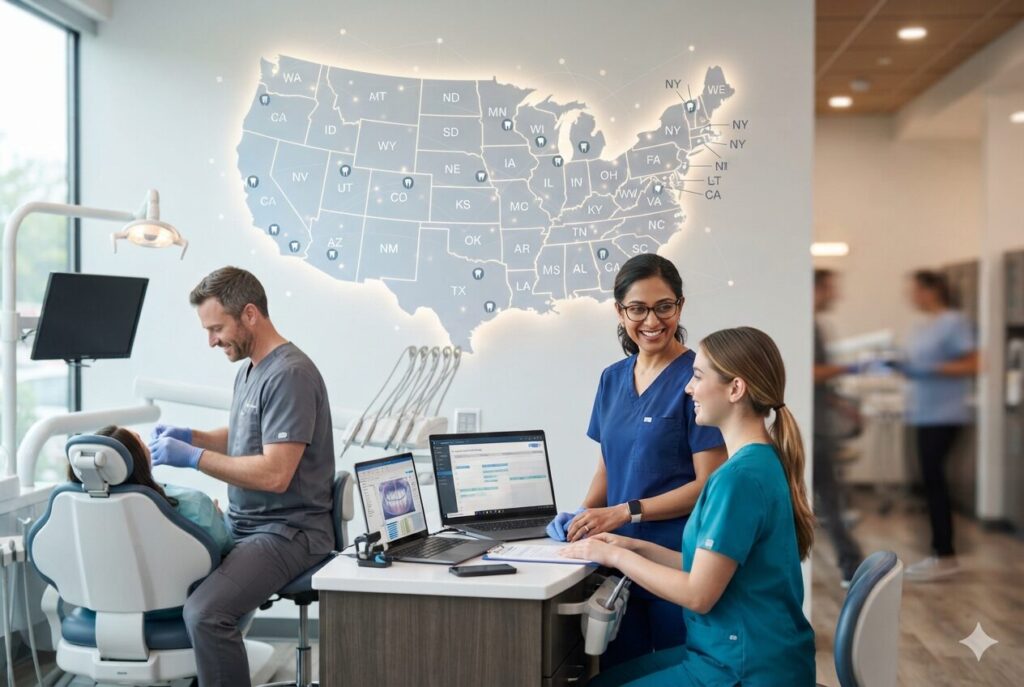
Mayday has dedicated local markets in six states, with network members available across all 50.
If you are checking whether your area is covered, the list below reflects the markets shown on our locations page at the time of writing.
- California: Los Angeles, San Jose, San Diego, Palo Alto, Anaheim, San Bernardino, San Francisco
- Texas: Houston, Dallas, Austin, San Antonio
- Florida: Fort Myers, Miami, Tampa
- Arizona: Phoenix, Tucson
- Nevada: Las Vegas
- Oregon: Portland
If your city is not on the list, coverage often exists before a local page does, and the team can check it for you. See the full locations page for current markets.
Questions to Ask on the First Call
- How many vetted professionals do you have within reach of my practice, and in which roles?
- Which credentials do you verify for each role in my state, and against which sources?
- How do you measure fill speed, and what is your typical number for same-day requests in my area?
- Can I see your rate sheet and your agreement before I request coverage?
- What happens if a professional cancels or the match is not right?
- Who do I contact after hours?
- Can you cover more than one of my locations, and does that change the terms?
Write down the answers and compare them side by side.
The agency that answers clearly and in writing is usually the one that will be easy to work with later. Our guide on how to choose the best temporary dental staffing agency adds a deeper evaluation framework.
A One-Page State Worksheet Before You Compare Agencies
Before you speak to anyone, spend ten minutes writing down your own requirements. It turns a vague search into a specific one, and it makes it obvious when an agency is dodging a question.
- The licensing board for your state and the link to its official license lookup.
- The roles you most often need to cover, ranked by how often you are caught short.
- Any certificate your state requires for those roles, such as radiography for assistants.
- How much of your coverage is planned, such as vacations and leave, and how much is same-day.
- The days and hours when you are hardest to staff, including evenings, Saturdays, and school holidays.
- Whether you want temporary help only, or an option to hire the right person permanently.
Hand this sheet to every agency you speak to. An agency that reads it and answers each line is already behaving the way a good partner should.
Special Case: Groups With More Than One Location
If your group spans several cities or states, coverage depth matters more than a single impressive number.
Ask whether one agreement covers every location, whether rates stay consistent between markets, and whether one contact manages requests across sites.
Standardizing how locations request and approve coverage saves time at the front desk and reduces mistakes. Our look at how multi-location practices can standardize hiring shows how groups set this up, and our guide to workforce planning for dental practices helps you decide how much of your coverage should be planned versus reactive.
Planned Coverage Versus Same-Day Emergencies
Many practices evaluate agencies only on emergencies, then discover the daily relationship matters more.
Planned coverage for vacations, maternity leave, and busy seasons is where a good agency earns trust, because there is time to match the right person.
Emergency coverage tests the bench and the process. Check both. Our guide to emergency dental staffing for same-day call-outs explains what a strong emergency process looks like.
Common Mistakes When Comparing Agencies
- Choosing on hourly rate alone and discovering conversion or cancellation costs later.
- Trusting a map pin as proof of local coverage.
- Accepting a fill-speed claim without asking how it is measured.
- Assuming the rules for assistants in your state match the state next door.
- Waiting until a chair is empty to ask for terms.
Frequently Asked Questions
How do I find a dental staffing agency near me?
Start with agencies that list specific local markets rather than only a state name, then ask how many vetted professionals they have within reach of your practice. A short call usually reveals whether their coverage is real.
What should a dental staffing agency cost in my state?
Rates vary by role, market, and urgency, so no single number applies everywhere. Ask for a written rate sheet for the roles you need, and compare conversion fees and cancellation terms alongside the hourly rate.
Do dental staffing agencies cover every state?
Some agencies serve many states through a national network, but depth varies. Ask about your specific city and role, because a state listed on a website does not guarantee professionals nearby.
How fast can an agency fill a dental hygienist shift?
It depends on the market, the notice you give, and the agency’s bench. Ask each agency how it measures fill speed and for a typical figure in your area. Planned shifts fill faster than same-day requests.
Are national agencies better than local ones?
Neither is automatically better. National agencies add scale and consistency, while local presence adds market knowledge. The best fit combines both, so ask any agency how it covers your city and your wider region.
Compare your options with real answers. Contact Mayday or call (888) 899-4386 to see what coverage looks like for your practice.